Visari

The AI-native operating system for eye care

Laser focused
on the patient.

We’re building one connected place for clinical care, practice operations and patient communication. Our goal: better patient outcomes and experiences, with less administrative work between people and the care they need.

In development · Starting with ophthalmology and optometry

Every part of the practice, working from the same whole picture of the patient.
58%

of office-based U.S. physicians say documentation takes time away from patient care.

JAMA Internal Medicine, 2022 · 2019 national survey
+24%

projected growth in demand for ophthalmic care by 2035, while ophthalmologist supply falls 12%.

Berkowitz et al., Ophthalmology, 2024
−32%

change in inflation-adjusted Medicare reimbursement for common ophthalmic procedures, 2015 to 2025.

Alshaikhsalama et al., Health Policy and Technology, 2026
41%

of providers say at least one in ten of their claims is denied, up from 30% in 2022.

Experian Health, State of Claims 2025 · 250 providers

Doctors want time to listen, examine and explain. The practice has to see more people, with less, and the software was not built for that. We believe the tools can carry more of the work, so that the doctor and team can give their attention to what matters most.

Getting paid is getting harder too. Nearly a third of medical group leaders say they now wait longer to be paid than a year ago, mostly because of payer delays and denials (MGMA, July 2026). Missed charges, denials and rework mean weaker cash flow, higher overhead and thinner margins. Because Visari’s billing work is built into the same record as the visit, with Ari part of it from the ground up, we’re designing it so coding, claims and follow-up start from what was documented instead of being re-entered.

The platform

A practice runs on more than its chart.

A patient’s care crosses the front desk, the exam room and the billing office. We’re building Visari from the ground up as one AI-native operating system for that entire journey, so information and work move with the patient instead of being re-entered at every step.

Exam room, surgery, orders

Clinical care

Ophthalmology charting, visit documentation, diagnostics, orders and e-prescribing. Designed to bring the patient’s story into focus and give doctors more room for clinical judgment.

From preparation to the signed record

Front desk, scheduling, billing

Practice operations

Scheduling, patient flow, authorizations, billing and the full revenue cycle. Connected workflows that help staff follow work through and keep the practice running.

From the first appointment to a resolved balance

Patient’s phone, before and after visits

Patient communication

Intake, reminders, messages, education and a patient portal. A clearer way for patients to prepare, ask questions and stay connected to their care team.

Before, between and after visits

The experience

Software that fits the person using it.

Time with the patient, and with each other, is everyone’s highest and best use in an eye care practice. The software should take care of the rest.

A fluid interface
Every practitioner works differently. Visari is designed so the data and screens present themselves in the way that is most intuitive for each person: a familiar paper-chart layout for one surgeon, a guided step-by-step flow for another, and the view each role needs, all on the same record.
Fewer clicks
No more wrestling with the EMR. Navigation, lookups and repeated entry are carried by the interface and by Ari, so each task takes the fewest steps it can.
Done before you go home
Our aim is to end after-hours documentation. The note is prepared as the visit happens and is ready to review and sign before the day is over.

In the prototype today

Real screens, fictional patients.

Visari is in development and not yet in use with patients. These screens come from our working prototype, with a fictional patient: one patient’s visit seen by two doctors in their preferred layouts and by the practice administrator, with Ari working beside each.

Focus Flow in the High Contrast theme for a fictional patient, with the encounter step guide across the top: history, vision and pressure, exam, diagnostics and imaging, procedures, assessment and plan, coding, and sign. The history is open, and Ari's sidebar shows a briefing that recommends an OCT and a pending question asking whether to record her patient-reported borderline sugar as prediabetes.
Focus Flow · High Contrast. The step guide walks the encounter from history to signature. Ari’s briefing recommends an OCT before any laser decision, and it asks before turning her “borderline sugar” into a coded diagnosis. Ari proposes; the doctor decides.
The same fictional patient in the Paper Chart layout, signed in as Dr. Yuri McKee. Ari has drafted a history entry from the patient's portal message, shown in blue with an Add to HPI button, and a patient-reported detail is underlined in yellow as a question for the doctor.
The Paper Chart · Dr. McKee. The same chart in another doctor’s preferred layout. Ari drafts the history from her portal message in blue and flags a patient-reported detail in yellow.
The clinic's patient flow board, signed in as the Practice Administrator. Ari answers two questions: who has waited longest, and where today's bottleneck is, suggesting the next two waiting patients move into tech workup.
Patient flow · Practice Administrator. Ari tells the administrator who has waited longest and where today’s bottleneck is, from the practice’s own flow history.

Meet Ari

An AI partner for the working day.

Our vision for Ari is an assistant that understands the task, carries the relevant context and helps each person finish the work.

Type, speak or use familiar controls. We’re designing an intuitive experience with fewer clicks, less repeated entry and more attention for the work that needs you. Ari prepares and proposes; the responsible person decides and signs.

Workflows we’re designing, by role

For doctors

Arrive at the visit prepared.

Bring relevant history together, help document the encounter and prepare next steps for review. The doctor retains final clinical judgment and signing authority.

For the front desk

Help the day move smoothly.

Coordinate registration, intake and scheduling, surface missing information, and help the team understand what needs attention before the patient arrives.

For the billing team

Keep the next action clear.

Connect the visit to billing work, help catch errors and investigate exceptions, and organize follow-up. The aim is less rework and fewer avoidable denials.

For patients

Make the next step easier.

Help patients share concerns, prepare for visits and understand their care. Clinical review of triage and scheduling suggestions helps direct patients toward timely, appropriate care.

What Ari does

In the moment, and in the background.

Ari is not a chat box bolted onto a chart. It is designed into every workflow, working beside people as they go and working ahead of them when nobody is looking. Here is how it works, and what it is being built to do.

Designing and buildingNothing on this list is in use with patients yet. Each capability is validated with doctors and staff before release.

  1. 1

    One shared context

    The chart, the schedule, the claim and the patient’s messages are one record, so Ari works from the same facts the team sees, with the source behind each one.

  2. 2

    Two ways of working

    With you: in the sidebar, by voice, or live during the visit. Ahead of you: timers and events start bounded work, such as preparing tomorrow’s visits or reviewing a new denial.

  3. 3

    People decide

    Proposals are marked and sourced. The responsible person accepts, edits or declines; only the doctor signs. When new information changes the picture, Ari revises the affected work and asks when it is unsure.

Background agents
Prepare the night before scheduled visits, review a new denial, or sort a new portal message. Each run records what it did, what needs review and what is blocked.
Ambient and interactive scribing
Listen during the visit and draft source-linked chart proposals. Interview the patient before the clinician continues, and hand over the history with the open questions.
Intelligent documentation
Draft the note, complete the codes behind what was entered, reconcile problems, medications and allergies, and keep every proposal traceable to its evidence.
Clinical decision support
Relevant findings, history and evidence beside the decision, with a basis the doctor can inspect. Advisory by design: the doctor makes the clinical call.
Operations support
Registration, intake, eligibility, scheduling and patient flow, with missing information surfaced before the patient arrives and the next action kept clear.
Revenue cycle
Coding support tied to the signed note, claims checked before they go out, denials worked up and appeals prepared for review. Authorized staff release the work.
Analytics
Room time, bottlenecks, throughput, billing errors and rework, and clinical quality measures with care gaps flagged while the patient is still in the office, computed from the work as it happens rather than from a separate reporting system.
Patient access
Portal messages answered with a prepared reply for review, concerns triaged for clinical attention, and patients directed toward timely, appropriate care.
Onboarding and implementation
AI-assisted mapping of legacy exports, practice setup and training, with human review of every uncertain match so clinical meaning is not lost in the move.
And what comes next
Every capability starts from the same shared context and the same rules of review, so each new workflow we add inherits what the rest already know.


For patients

Care that is easier to be part of.

The point of all of this is the person in the chair. Patients should be able to prepare for a visit, understand what was decided and reach their care team without chasing anyone.

  • In the buildA patient portal with scheduling, appointments, paperwork, messages, records and refill requests.
  • In the buildA phone check-in where patients describe a new concern in their own words, answer safety questions and take an open appointment.
  • In the buildIntake and preparation by conversation, so concerns reach the care team before the encounter with the physician.
  • In the buildConnections to the apps and personal AI assistants patients already use, with the patient’s permission.
  • In the buildRecord sharing across care teams, including referring doctors, co-managing doctors and surgery center staff, through their own secure portals, with direct access to our doctors’ open appointment times when authorized.
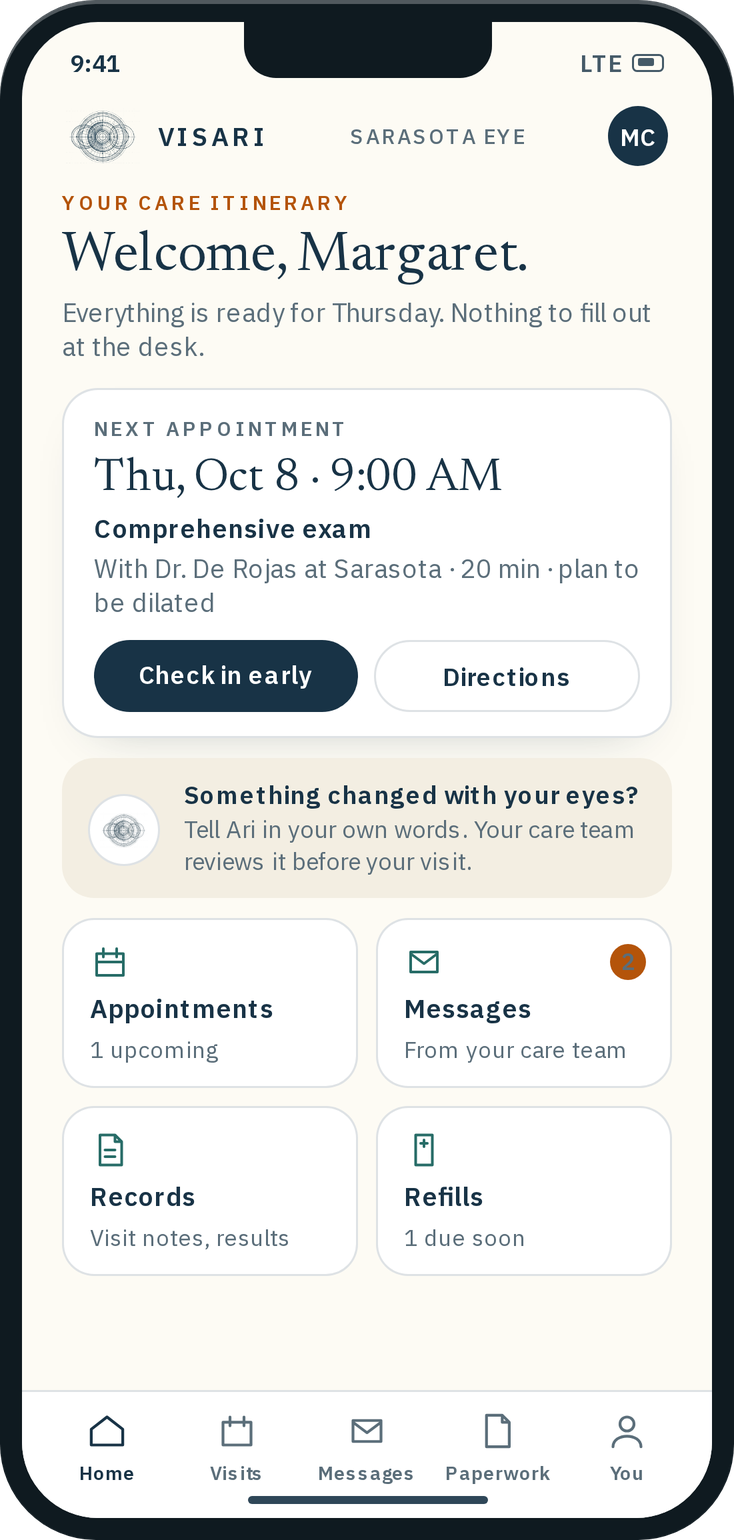
The Visari patient portal on a phone: Welcome, Margaret; her next appointment with a check-in button; a prompt to tell Ari in her own words if something changed with her eyes; and tiles for appointments, messages, records and refills.
The patient portal, designed for her phone. Every patient shown is fictional.

Our approach

Better care. A stronger practice.

Our goal is to return time to doctors and staff, improve the patient’s experience and help practices serve more people. Privacy, security and human accountability guide how we build.

Finish the whole job

Design around what each person needs to accomplish, including the work that crosses screens and teams. Give AI clear boundaries and keep consequential decisions with the responsible person.

Make switching easier

We’re developing AI-assisted migration, setup and onboarding tools to reduce the time and effort of a move. Human review remains essential when information is uncertain.

Measure what improves

We plan to measure time returned, operating costs, billing errors and rework. Cost savings and revenue recovered through better billing and follow-up will be measured separately.

Secure and certification-ready by design.

Healthcare software has to earn trust before it earns time. We build to the standards a clinical system of record requires, from the first line of code.

Certification
Built to meet ONC Health IT certification requirements, which we plan to complete before launch.
Privacy
A HIPAA business associate agreement with every practice before any patient information is entered.
Protection
Encryption in transit and at rest, on Google Cloud in the United States, with two-step sign-in for staff.
Accountability
Every view and change of a patient’s record is logged, and every Ari action records its sources and who approved it.
Standards
A clinical record built on FHIR, the healthcare interoperability standard, so information can move with the patient’s permission.
Engineering
Security and engineering best practices throughout: least-privilege access, code review, automated testing and controlled releases.

Founders

Built by doctors who know the work.

Visari brings together ophthalmic surgery, practice and surgery-center operations, medtech startup experience, hands-on AI development and the day-to-day experience of practice professionals.

Joaquin De Rojas

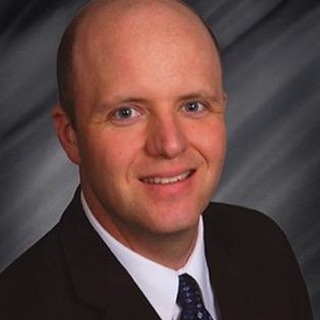
Joaquin De Rojas, MD

Founder & CEO

Ophthalmic surgeon and AI developer. Former medical director of one of the most successful eye care practices in the United States, with medtech startup experience. He has built AI software used by doctors and practices.

About Joaquin
Yuri McKee

Yuri McKee, MD, MS

Co-founder & Chief Medical and Strategy Officer

Ophthalmic surgeon, practice founder and educator, with multiple founder and advisory roles in medtech and biotech startups. Yuri brings decades of clinical and surgical experience to the design of Visari.

About Yuri

Doctors, practice administrators and billing professionals help shape the workflows and the questions we need to solve.

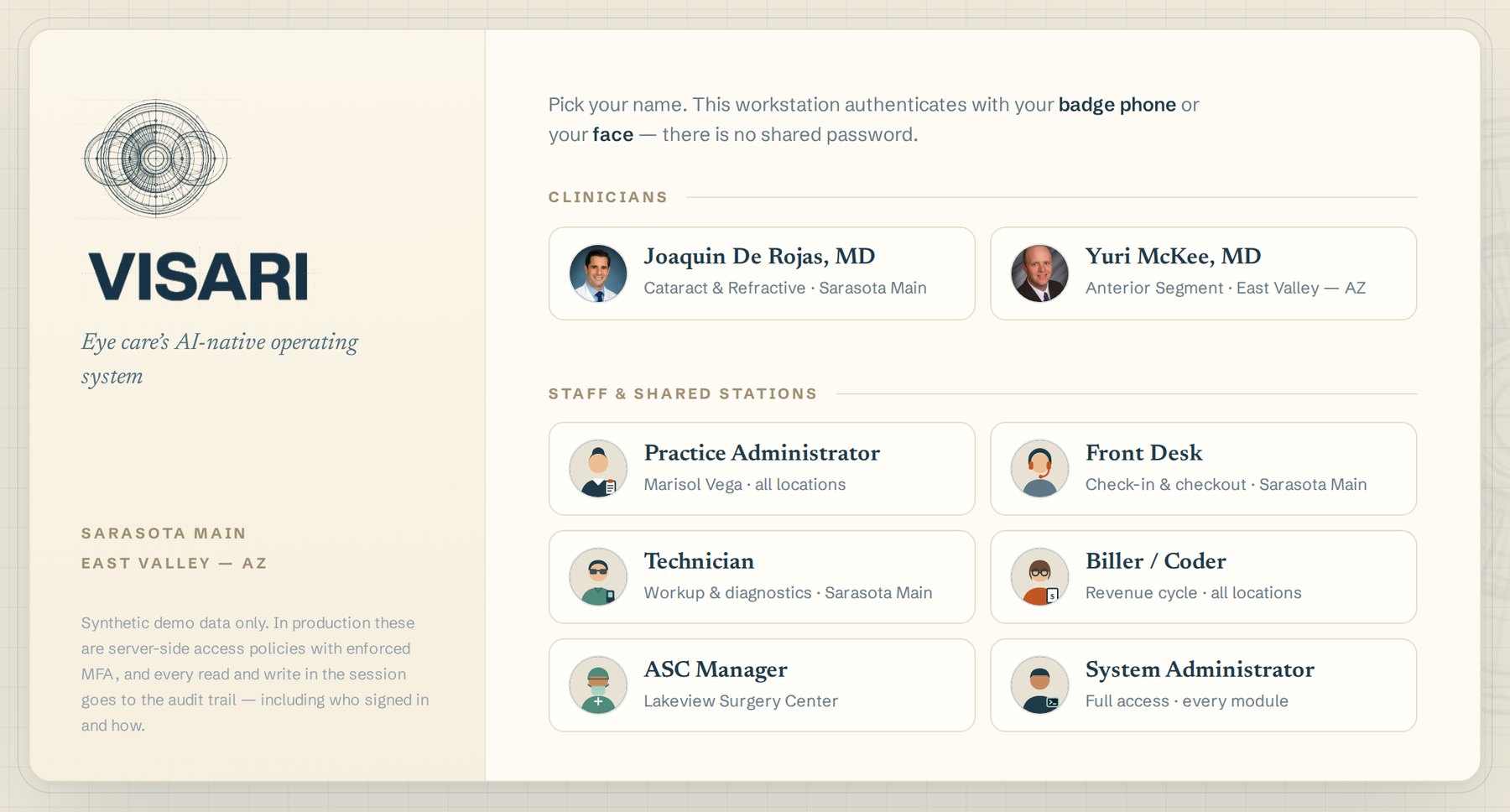
The Visari sign-in screen from the prototype: clinicians Joaquin De Rojas, MD and Yuri McKee, MD, and staff stations for the practice administrator, front desk, technician, biller and coder, surgery center manager and system administrator. Each person signs in with a badge phone or their face, with no shared password.
One system for the whole practice. Doctors, front desk, technicians, billing, the surgery center and administrators each sign in to their own view of the same record, with a badge phone or their face and no shared password. From the prototype; staff shown are fictional.

Where we’re going

More informed patients. More connected care.

We’re building a patient portal that connects with people’s chosen apps and personal AI assistants, and record sharing across care teams with the patient’s permission. The aim is a more informed, collaborative relationship between patients and their doctors.

Ophthalmology and optometry are our starting point. Our long-term ambition extends across eye care and other ambulatory specialties, building on what we first prove in practice.

Visari is in development and is not yet available for patient care. Launch depends on validating workflows and meeting applicable readiness requirements.

Questions about Visari

Help shape a better day in practice.

We’d like to hear from doctors, practice teams and people who share our vision.

Get in touch